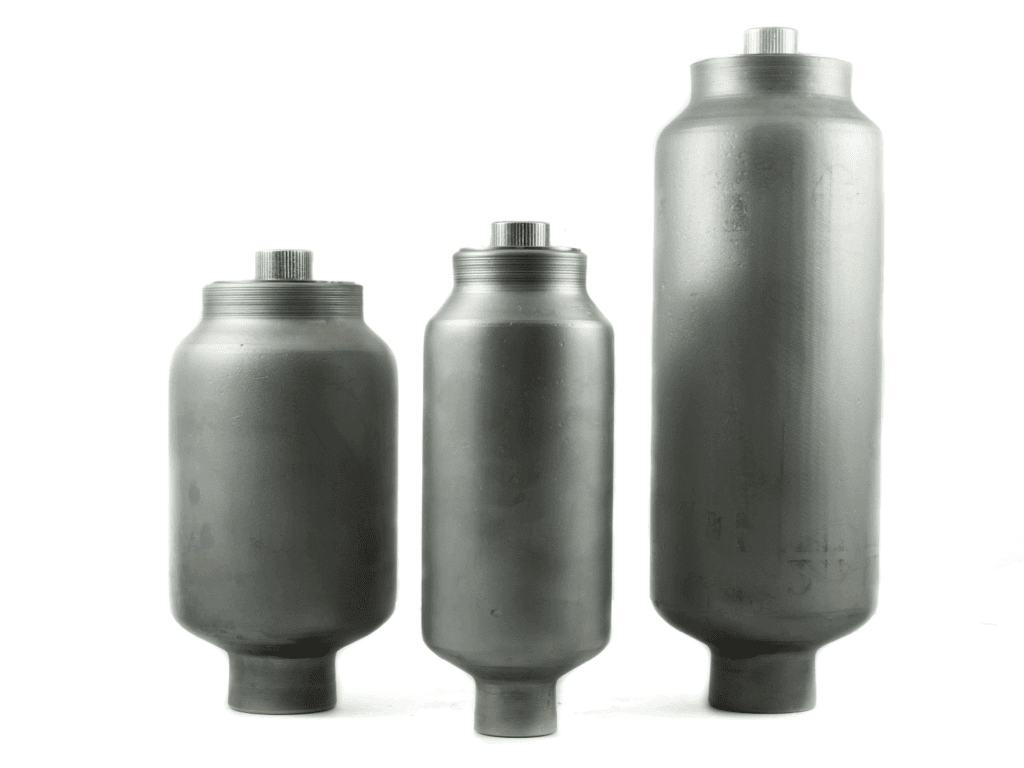
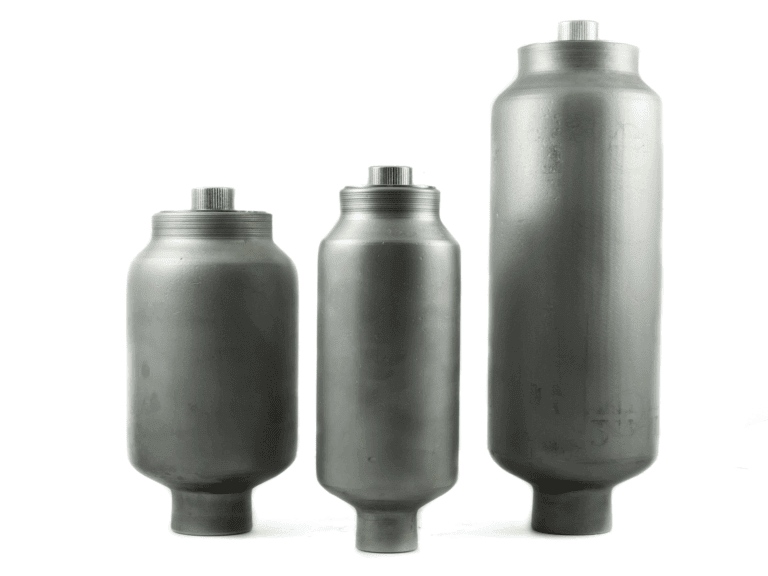
What is a Pulsation Dampener?
A pulsation dampener is equipment that dampens the pressure and flow fluctuations (pulsations) created by positive displacement pumps, ensuring a smoother and vibration-free flow.
Especially for:
- Diaphragm metering pumps (API 675 applications)
- Peristaltic pumps
- Piston and plunger pumps
- Twin screw / lobe pumps
It is used to reduce vibrations in the outlet line of pumps operating with strokes (beats).
Why Use It?
Problem | Reason | Benefits of the Dampener |
Flow fluctuation | Stroke movement in the pump | Smooth & continuous flow |
Pressure shocks (water hammer) | Sudden valve closure, stroke start | Reduces impact loads |
Pipeline vibration | Irregular momentum transfer | Noise & vibration are reduced |
Instrumentation error | Flow/pressure sensors fluctuate | Provides accurate measurement |
Diaphragm & hose life shortening | Excessive stress | Extends maintenance time |
Equipment fatigue | Pressure oscillations | Mechanical safety increases |
➡ In other words, it protects both the system, the pump, and the instrumentation.
Structure (Main Components)
Pulsation dampeners basically include the following parts:
- A pressure chamber (gas chamber) in the body
- Gas compartment → usually nitrogen
- Separator element → Diaphragm, bladder, or piston
- Process fluid connection
- Gas filling valve
There is a flexible surface between the gas and liquid → provides compressibility.
Working Principle
The positive displacement pump creates a pulse effect with each stroke:
- When the pump stroke pressure increases:
- Liquid enters the dampener
- Gas volume compresses → absorbs energy
- When the stroke pressure drops:
- Compressed gas expands back
- Transmits the liquid back to the line with the stored energy.
Since this is repeated quickly, the flow becomes almost continuous.
Types
Type | Advantage | Area of Use |
Bladder (balloon) | High pulsation damping | Industry, oil & gas |
Diaphragm separator | Corrosion resistant, hygienic | Food, medicine |
Gasless types | Maintenance free | Small systems |
Metal diaphragm | High pressure | Chemical processes |
✔ Material selection is made according to the fluid chemistry (PTFE, EPDM, FKM, etc.)
Correct Positioning
- As close as possible to the pump outlet
- Close to the highest point on horizontal lines
- Maintaining distance after vortices and elbows
API 675 & API 674 standards recommend a damper/control valve combination.
Sizing Criteria
- Pump stroke volume and speed
- Line pressure and pulsation percentage (5% – 10% target)
- Fluid viscosity
- Maximum working pressure
- Heat, corrosion, and hardness requirements
- Gas pre-charge pressure
The pre-charge pressure is generally set around 60-80% of the operating pressure.
Summary of Usage Benefits
Benefit | What Does It Provide? |
Smoother flow | Quality & controlled process |
Less vibration & noise | Comfort & safety |
Pump & hose life increase | Maintenance cost decreases |
Measurement equipment accuracy increases | SCADA & control improves |
Energy saving | Efficiency increases |