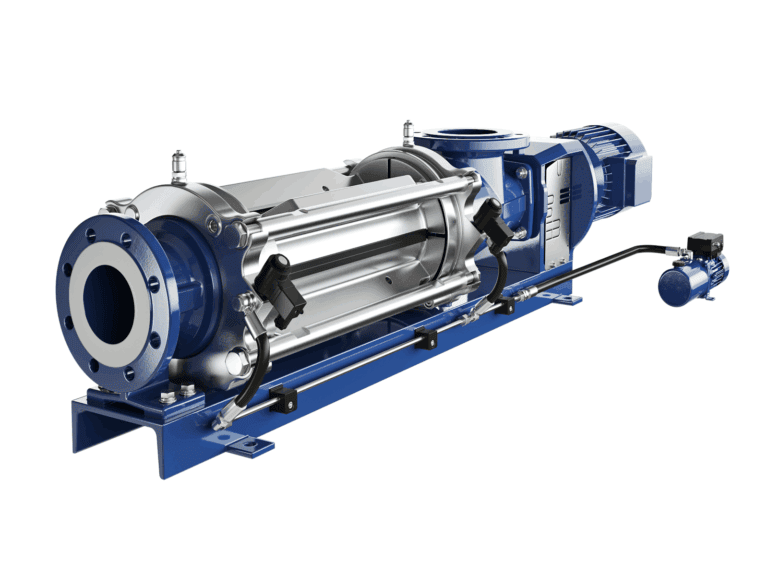
How Do Progressing Cavity Pumps Work?

Progressing cavity pumps are positive displacement pumps that operate on the principle of using a helical 'screw' shaped rotor and stator arrangement to move fluid. This system draws fluid by creating temporary cavities, then transports the fluid through these cavities and discharges it through the outlet port.

A typical progressing cavity pump has a suction inlet connected to a long pump housing. Inside this housing is the helical rotor and stator assembly.

  • The helix of the rotor is designed to be eccentric to the stator, and temporary cavities are formed within this arrangement.
  • As the rotor rotates in an eccentric motion, these cavities form, drawing fluid and moving it towards the pump.
  • The fluid advances through the pump and is discharged through the outlet.

Which Fluids and Applications Are Progressing Cavity Pumps Suitable For?

These pumps are ideal for transporting high-viscosity fluids over long distances. The outlet pressure can reach up to 48 bar. It is commonly used for the following substances:

  • Sludge, sludge mixtures, and sludge cake from wastewater treatment plants
  • Liquids used in anaerobic digester plants and paper recycling plants
  • Dosing of high-viscosity additives and chemicals

These pumps can be offered in special models for dosing viscous fluids, use in hygienic environments, and drum emptying operations.

Progressing Cavity Pump Types

These pumps can be adapted with different accessories and configurations to suit the challenges of the fluid to be transported.

Examples include:
✔ Different screw and vane feed inlets to break up solid particles
✔ Mechanical seal systems that provide protection against highly abrasive substances
✔ Hygienic compliant materials and configurations
✔ Dosing type pumps (compact design)
✔ Drum emptying units with vertical design

These pumps should not be run dry, as the heat generated by the rotor and stator can cause damage due to excessive temperature. However, there are various accessories available that prevent dry running, both on the suction side and in the pump itself.

Progressive Cavity Pump Geometry

These pumps can have geometries that vary in different proportions. Geometry determines how effectively the fluid will be transferred from one cavity to another and the level of sealing.

  • Standard geometry is suitable for thicker materials because the pitch adapts to the viscosity.
  • Long geometry operates more efficiently with a lower slope and a wider rotor-stator contact surface.