Why Use It?
A relief valve is vital in the following situations:
Risk | Role of the Relief Valve |
Equipment may be damaged if the pressure rises uncontrollably | Discharges excess pressure |
Pump dead heading | Protects the pump from overloading |
Pressure increase due to thermal expansion | Reduces pressure to a safe level |
Sudden pressure surges in the installation | Ensures system safety |
Human and environmental safety | Prevents accidents |
A pressurized system without a relief valve poses a serious hazard.
Structure (Basic Components)
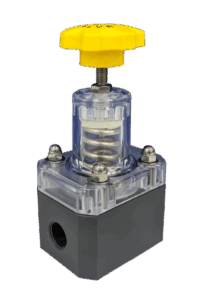
A relief valve usually consists of the following parts:
- Valve body
- Inlet and outlet connections
- Piston or disc (part that sits on the valve seat)
- Spring → Maintains the set pressure
- Set screw → Determines the operating pressure
- Cover and guiding system
Thanks to the tight closing of the disc with the spring on the valve seat, there is no flow passage during normal operation.
How Does It Work?
The working principle is based on the balance of pressure and spring force:
- When the pressure in the system is below the set pressure value:
- The spring force keeps the disc closed
- Fluid is not discharged
- If the pressure exceeds the set pressure level:
- The pressure force overcomes the spring
- The disc lifts and fluid is discharged
- Pressure starts to drop
- When the pressure drops back to a safe level:
- The spring closes the disc again
- The system returns to normal
These processes take place very quickly and provide continuous control.
Relief Valve Types
Type | Usage Feature |
Spring-loaded | The most common type, in pumps and hydraulic systems |
Pilot-operated | High flow rate and precise pressure control |
Thermal relief | Only for thermal expansion pressure |
Vacuum relief | Protects against negative pressure |
Safety Valve (PSV) | With sudden opening and closing in pressure vessels |
Selection Criteria
The following parameters should be considered when selecting a relief valve:
- Set pressure (safety pressure)
- Min./Max. operating pressure
- Fluid type (corrosive, viscous, gas, steam)
- Discharge flow rate
- Material selection (SS, bronze, cast iron, PTFE gasket, etc.)
- Standard requirements such as ATEX, API, ASME