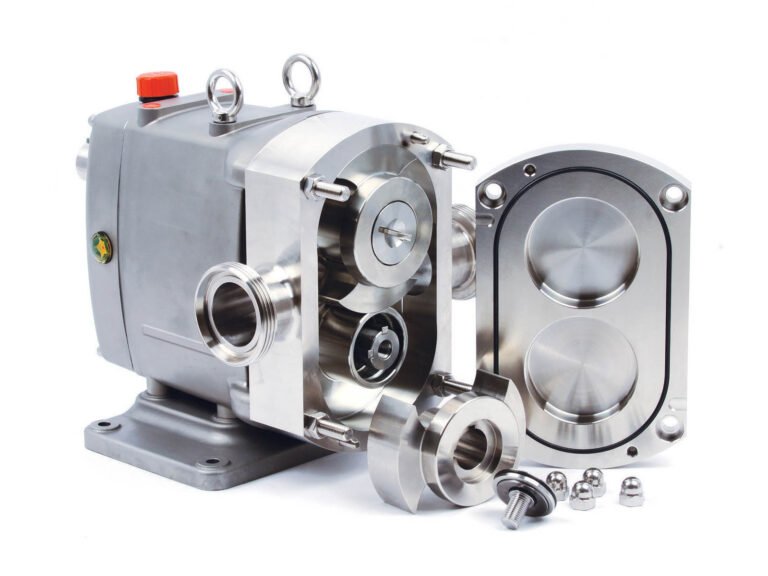
What is a Hygienic Pump?

In industrial production, there are specific purity and hygiene standards set for each process.
However, especially in the food industry and pharmaceutical production, much stricter rules apply to prevent contamination of these products.
Therefore, special hygienic machines and systems are used in both sectors.
Hygienic pumps, especially those that come into direct contact with products, are of critical importance.

Hygienic Pumps

To meet the special requirements of the food and pharmaceutical industries, hygienic pumps have certain design details that distinguish them from other types of pumps. These pumps focus specifically on the following features:

  • Cleanability
  • Cavity-free structure
  • Absence of dead space
  • Vertical model (for multi-stage pumps)

To ensure easy cleaning of hygienic pumps, smooth materials and surfaces are used as much as possible and made suitable for regular cleaning with acids and bases.
Cavity-free O-rings supported by metal stoppers are used to prevent cavity formation.
Dead spaces are areas where liquid can accumulate inside the pump and lead to contamination – especially in the impellers or vanes of hygienic centrifugal pumps. Therefore, hygienic centrifugal pumps are equipped with open impellers and vanes.

Multi-stage models are available for hygienic centrifugal pumps that need to carry large quantities of liquid; that is, designs in which several impellers are arranged one after the other are used. Thanks to the vertical structure, these pumps can be completely emptied, which prevents the risk of contamination.

There are also various models among positive displacement pumps (volumetric pumps) that meet hygiene standards. These pumps can be used for low-viscosity liquids, but are especially suitable for high-viscosity liquids. Hygienic positive displacement pumps perform very effectively in filling and mixing systems.

Pump Technologies That Can Be Used for Hygienic Pumps

Various pump technologies can be used to meet the specific requirements of food and pharmaceutical production. When pumping low-viscosity liquids, centrifugal pumps that comply with hygiene standards are often preferred.

Positive displacement pumps are ideal for high-viscosity liquids in particular. Progressive cavity pumps and rotary piston pumps can transport dense liquids such as sauces and pastes gently and under pressure. In addition, hygienic twin-screw pumps are particularly suitable for slippery and pure liquids and can transport even large quantities of high-viscosity liquids. Besides, pump manufacturers also offer alternative technologies such as peristaltic pumps and diaphragm pumps that comply with hygiene standards.

Housings and Certifications for Hygienic Pumps

  • Housings

To prevent deposits and contamination during operation, the environmental components of hygienic pumps must also be suitable for use in the food and pharmaceutical industries.

This particularly affects the drive components: Motors and gearboxes used in the food and pharmaceutical sectors must be equipped with housings made of easy-to-clean and wear-resistant materials that do not contain dead spaces, just like pumps. In addition, these components must be designed to resist aggressive acids and bases. In addition, the housings must be splash-proof to prevent water from entering the interior.

  • Certifications Guaranteeing the Suitability of Hygienic Pumps

To prove that a pump is suitable for hygienic use in the food industry or for sensitive drug production, companies should prefer hygienic pumps that have been tested by organizations such as EHEDG (European Hygienic Engineering & Design Group) or 3A Sanitary Standards.

In the USA, the FDA (Food and Drug Administration) sets certain standards, while in Europe, GMP (Good Manufacturing Practice) regulations must be taken into account, depending on the sector. In addition, some large corporate groups may also set their own corporate hygiene standards.

Hygiene controls carried out by independent organizations primarily evaluate factors such as surface quality, material selection, design, and documentation. Hygienic pumps that successfully pass these audits are entitled to receive a certificate of conformity.